


Consulting website examples are useful when they show how a firm makes its expertise understandable, supports its claims and helps the right buyer start a conversation. A homepage alone cannot explain a complex advisory engagement. Buyers also need to understand the problem you address, who will advise them and what happens after they enquire.
For consultancy founders, partners and professional service leaders, the practical question is: which website decisions fit our business? This guide analyses three companies, then translates the lessons into service structure, evidence, navigation and diagnostic priorities. ICONCLY Business provides a relevant starting point through diagnosis, positioning and authority planning before redesign decisions are made.
What makes a consulting website effective?
A consulting website is a professional platform that explains an advisory firm’s expertise, services, people and approach, with a clear route for prospective clients to assess fit and make contact.
It should answer five questions:
- Who does this firm help?
- Which business problems does it address?
- What does an engagement involve?
- What evidence supports its credibility?
- What should an interested buyer do next?
Different visitors need different answers. A chief executive may assess strategic relevance; a functional leader may examine methods; procurement may need company information and engagement boundaries. The site should support these decisions without forcing everyone through the same introduction.
Three consulting website examples and practical lessons
These observations concern public pages reviewed in November 2026. McKinsey, Bain and Thoughtworks are external references, not claimed ICONCLY clients. The analysis evaluates communication choices; it does not establish conversion performance or attribute their websites to ICONCLY.
1. McKinsey: connect expertise with useful thinking
McKinsey’s homepage combines reports, articles, conversations and other editorial formats with pathways into industry expertise and capabilities. Visitors can explore ideas before investigating the firm’s services.
The useful lesson is the relationship between thinking and commercial relevance. For a specialist consultancy, a small collection of substantive articles can help buyers examine its reasoning.
Apply this by:
- Publishing insights about decisions your clients actually face.
- Giving each article an identifiable author and clear scope.
- Linking relevant analysis to the service it helps explain.
- Keeping service information accessible to visitors ready to enquire.
A boutique practice does not need a large publishing operation. Three carefully maintained pieces demonstrating a distinctive method can be more manageable than an ambitious archive that becomes outdated.
2. Bain: give complex firms recognisable entry points
Bain’s website provides industry navigation, an insights pathway and a directory of offices and regional options. These routes acknowledge that a global firm serves different sectors and markets.
For smaller consulting companies, the principle is selective navigation. Organise around the distinctions buyers use to choose advice.
Consider separate routes when:
- Industries require materially different knowledge or evidence.
- Service lines solve different buying problems.
- Regional teams have distinct capabilities or contact arrangements.
Avoid copying the scale of a global navigation menu. A focused consultancy may need only Services, Expertise, Insights, About and Contact. A new industry page should add relevant context, methods and proof rather than repeat another page with a sector name replaced.
3. Thoughtworks: make the offering and supporting work discoverable
Thoughtworks’ homepage identifies the business as a technology consultancy and explains activities including modernising systems, redesigning workflows and developing products. It also provides routes to client work, publications and contact.
The practical lesson is specificity. Buyers can connect a broad category with actual work, then investigate supporting material.
For an advisory firm:
- Name the type of consultancy plainly.
- Explain the decisions, systems or processes involved.
- Give prospective clients access to relevant project evidence.
- Provide a contact invitation connected to their challenge.
Thoughtworks’ published project figures are its own claims. They are not benchmarks for another consultancy. Learn from how evidence is organised; use only your firm’s verified evidence when describing your capabilities.
Translate the examples into your company’s website
Define the audience and the buying situation
Start with a business problem, rather than an exhaustive list of industries. A finance advisory firm might help leadership teams prepare for investment, improve reporting or review financial controls. These are different engagements, even when the same company could need all three.
For each priority offer, specify the buyer, trigger, constraints and expected decision. This helps determine which service deserves a dedicated page and which belongs within a broader service description.
Explain services through scope and deliverables
A service page should help a buyer evaluate an engagement. Include:
- The circumstances in which the service is relevant.
- The business questions it addresses.
- The information or access required from the client.
- The stages of the engagement.
- The deliverables and how they support decisions.
- The boundaries between advisory work and implementation.
For example, an operational review could produce a process map and prioritised recommendations. Those outputs should not be presented as guaranteed efficiency gains. Explain the work accurately, then state what affects implementation.
Show the people behind the advice
Include named advisers, relevant roles, areas of expertise and accurate professional credentials. Explain who leads the engagement and whether specialist support is involved.
For founder-led firms, distinguish the founder’s personal experience from the company’s completed work. A partner’s previous employment does not automatically make a former employer’s client an engagement delivered by the current firm.
Build evidence buyers can evaluate
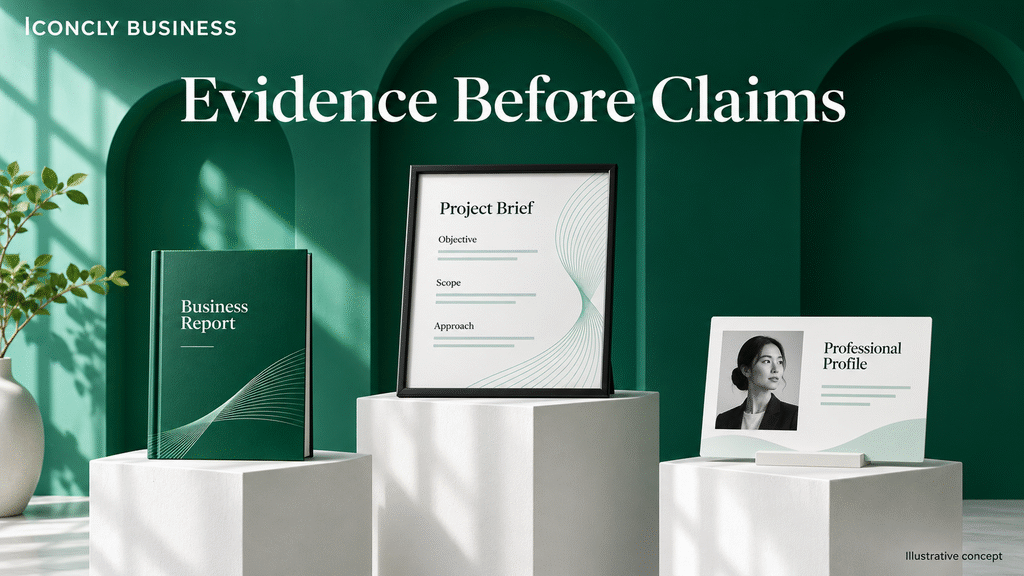
Credibility needs context. A row of logos says little about the work performed and may require permission. A useful case study explains the original situation, scope, your role, the work completed and the outcome that can be substantiated.
Where confidentiality prevents naming a client, an anonymised example can still explain sector, project boundaries and methodology. Remove identifying details and obtain the necessary approvals. Label illustrative scenarios clearly.
| Evidence type | Useful information | Boundary to preserve |
|---|---|---|
| Project case study | Challenge, scope, role and documented outcome | Do not imply sole responsibility for a shared result |
| Professional profile | Relevant experience and verified credentials | Separate individual experience from company engagements |
| Methodology | Stages, decision criteria and deliverables | Avoid implying that a process guarantees an outcome |
| Client testimonial | Approved wording and relevant context | Obtain permission and preserve the original meaning |
Place evidence beside the service it supports. Buyers should not need to search an unrelated page to understand why a particular claim is credible.

Design an enquiry route suited to consulting
Consulting enquiries often involve uncertainty. A visitor may understand the problem without knowing which service to request. A diagnostic conversation can therefore be a useful first step when its purpose is explained.
Use a specific invitation, such as “Discuss your reporting challenges” or “Request a website diagnosis”. Explain who the conversation is for, what information to prepare and what happens next. Only publish response times or availability that your team can maintain.
Keep initial forms proportionate: name, business email, company and a short challenge description may be sufficient. Avoid asking for confidential financial records or sensitive client information through a general marketing form.
Provide working email and telephone options. Test mobile interactions, successful form delivery, confirmation messages and ownership of incoming enquiries. A contact-button click is not the same as a received enquiry or a qualified opportunity.

Start with an ICONCLY diagnostic before deciding to redesign
An unclear website can reflect an unclear offer, scattered evidence or an unsuitable buyer journey. Replacing the interface before investigating these issues can preserve the underlying problem.
ICONCLY Business presents its Diagnostic Audit as an assessment of market position, brand clarity, competitive context and growth constraints. For a consultancy reviewing its website, the starting conversation should establish how these questions connect to the digital experience and which deliverables belong in the agreed scope.
When a diagnostic is particularly useful
Consider diagnosis when:
- Visitors repeatedly misunderstand what the company actually does.
- Enquiries come from buyers outside the intended service scope.
- Partners describe the firm’s positioning differently.
- Strong project experience is difficult to find or substantiate online.
- Several services compete for attention on the homepage.
- The business is entering a new sector or changing its offer.
- A redesign is proposed without evidence of the current constraint.
These signs are investigation prompts. They do not prove that design, traffic quality or positioning is the cause.
What to investigate before prescribing changes
A useful website diagnostic brief should connect commercial and digital questions:
- Positioning: which buyers should recognise the firm’s relevance?
- Offer clarity: can visitors distinguish services and their boundaries?
- Evidence: are credentials, methods and project claims supported?
- Buyer routes: can each priority audience find the appropriate next step?
- Enquiry handling: do requests reach the right person with enough context?
- Measurement: can the company distinguish traffic from meaningful opportunities?
Share the current website, priority services, sales questions and available analytics when appropriate. Ask for the diagnostic scope, required inputs, deliverables and responsibilities before commissioning work.
Turn findings into a prioritised website brief
A practical diagnostic outcome should help leadership decide what to change first. Depending on the agreed engagement, the resulting brief may prioritise positioning, service architecture, proof collection, enquiry routing or technical investigation.
For example, if buyers misunderstand a specialist service, clarify the offer before adding more traffic. If qualified visitors cannot submit enquiries, investigate that journey before commissioning additional content. If evidence is missing, assign an owner to gather approved project material.
Discuss a diagnostic review with ICONCLY to establish the questions your consultancy needs answered before committing to a redesign.
How ICONCLY connects website priorities with business authority
Positioning before page design
ICONCLY’s Positioning Strategy pathway addresses market position and differentiation. For consulting firms, this can inform audience priorities, offer language and the distinctions the website needs to communicate. The exact outputs should follow the diagnostic findings and agreed engagement.
Authority website planning
The Authority Website Design page describes buyer intent mapping, page structure, proof placement, messaging flow and enquiry pathways. These are useful planning areas when expertise is difficult to evaluate online.
Its relevance extends beyond the homepage: a consultancy needs coherent service pages, accessible evidence and a contact journey that matches the buying decision. Confirm implementation ownership, technical responsibilities and ongoing support in the proposal.
A connected authority system
A website also needs consistency with the firm’s wider professional presence. ICONCLY’s published pathways include personal branding, LinkedIn authority and thought leadership content. These can inform how adviser profiles, professional messaging and useful insights support the same positioning.
The Growth System program provides a broader strategic context for channels, content and authority infrastructure. ICONCLY’s homepage describes the Business practice as advisory only; confirm the scope and delivery arrangements for any execution services separately.
Make consulting website content clear for search and AI discovery
Use descriptive page titles, one clear H1 and a logical heading sequence. Give each service a distinct purpose and connect related insights through useful internal links. Explain specialist terms, identify authors accurately and cite sources where factual claims need support.
For search and AI systems, prioritise accessible, specific information: the company name, expertise, service scope, people, methods and evidence. Technical checks should cover crawlability, indexing, canonical URLs, mobile usability and functioning navigation.
Use structured data only for accurate page information. It does not guarantee rankings or inclusion in AI answers. Google’s AI features guidance explains that established SEO practices remain relevant and that no additional technical requirements are needed specifically for its AI features.
Review the website as a leadership team
Before approving a new structure, ask a partner, a recent client and someone unfamiliar with the business to review the same priority page. Ask each person to explain the offer, identify the evidence and describe the next step. Differences between their answers can reveal ambiguity that internal familiarity hides.
Assign ownership for the information behind each page:
- A service leader validates scope and deliverables.
- A project owner checks case study accuracy and permissions.
- A named adviser confirms their biography and credentials.
- A commercial owner reviews enquiry quality and follow-up.
- A technical owner maintains forms, accessibility and measurement.
For companies with several partners, agree terminology before creating separate service pages. Otherwise, overlapping descriptions can make related offers appear interchangeable. Record the final decisions in a shared brief, then review whether the website still reflects the business when services, people or priorities change. This makes maintenance a management responsibility, supported by clear editorial and technical ownership.
FAQs about consulting website examples
Should we copy a leading consultancy’s website?
Use examples to identify useful principles. Your navigation, content volume and evidence should reflect your own services, team and buyers. Copying another firm’s language or layout cannot establish your expertise.
What should a small consulting website include?
Start with a clear homepage, focused service information, adviser profiles, relevant evidence and contact details. Add insights when the team can maintain useful, accurate material.
Can a consultancy publish case studies without naming clients?
Yes, when confidentiality and permissions are respected. Explain the work accurately, remove identifying details and distinguish documented outcomes from illustrative examples.
Should we redesign before commissioning a diagnostic?
Investigate the problem first when the reason for underperformance is unclear. A diagnostic can help decide whether positioning, evidence, navigation, enquiry handling or technical work deserves priority.
How can we start with ICONCLY?
Request a diagnostic conversation and share your website, priority services and main commercial concern. You can also email ICONCLY Business or call the team to discuss fit and the appropriate scope.