


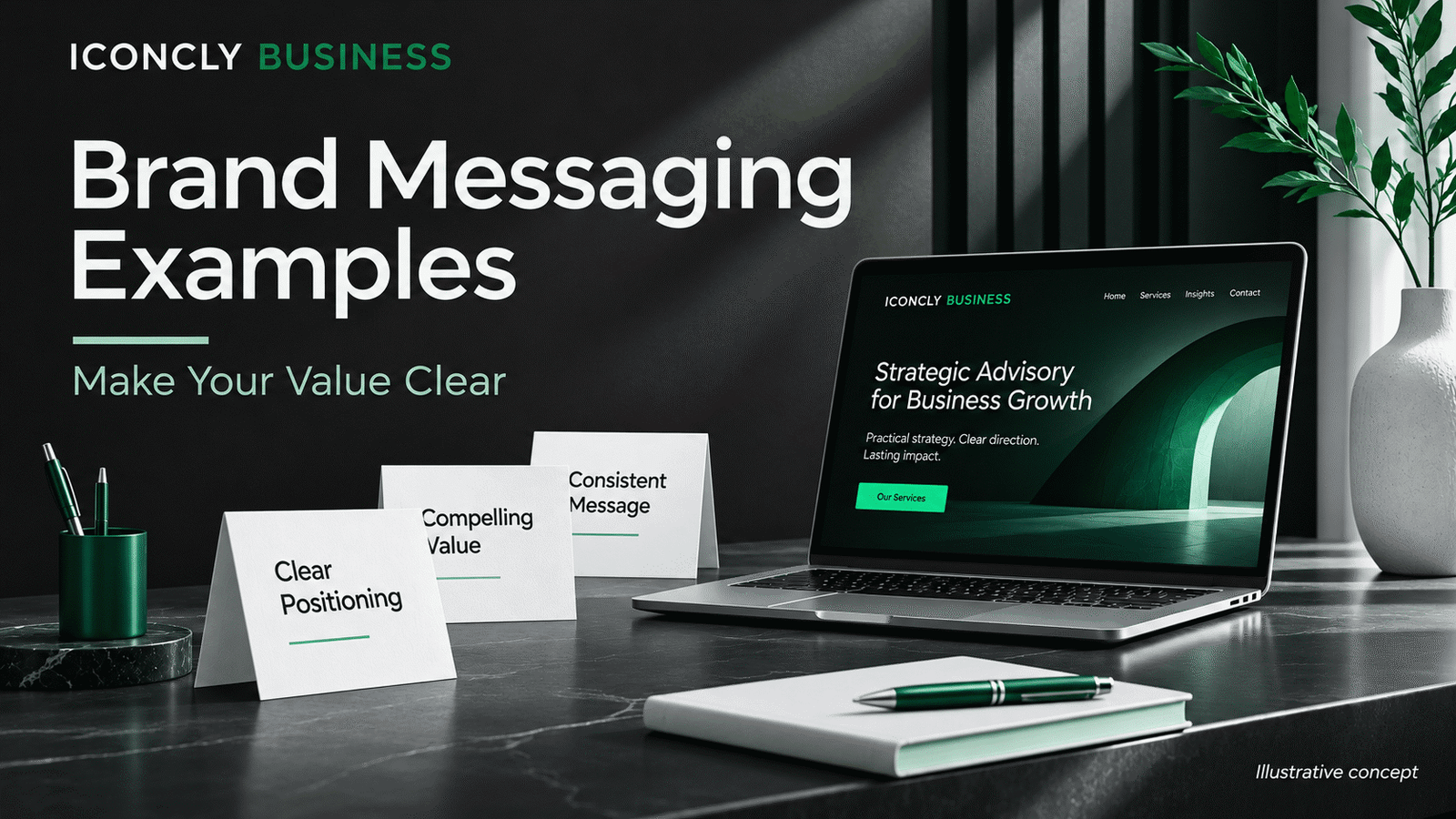
Brand messaging examples show how a business explains its audience, value and relevance in language buyers can understand. The useful examples do more than sound memorable: they connect a clear promise with specific information that helps someone decide whether to explore further.
For founders, consultants and premium service businesses, that distinction matters. A polished website can still leave buyers asking what the company actually does, who it serves and why its approach deserves attention.
This guide examines three real brands, then applies the lessons through practical examples for professional service firms. You will learn how to evaluate a message, connect claims with evidence and create a consistent direction for your website, founder profile and sales conversations.
What is brand messaging?
Brand messaging is the system of ideas and language a business uses to communicate what it does, who it serves, why it matters and what supports its claims. It includes a core message, supporting themes, proof points and practical guidance for different communication channels.
A slogan can be part of that system, but cannot carry the whole explanation. A service firm might have a memorable headline while still needing clear descriptions of its audience, scope, method and next step.
Think of messaging as a hierarchy:
- Core message: the central idea buyers should understand.
- Value proposition: the relevant benefit of the offer.
- Supporting pillars: the themes that explain that value.
- Proof points: the information that makes each claim credible.
- Calls to action: the appropriate next step for an interested buyer.
Brand messaging, positioning and tone of voice: the difference
| Element | Main question | Practical output |
|---|---|---|
| Positioning | Where should buyers place us relative to alternatives? | Audience, category, differentiation and competitive context |
| Messaging | How do we explain that position clearly? | Core message, benefits, supporting themes and evidence |
| Tone of voice | How should the communication sound? | Guidance on language, formality and expression |
| Tagline | What short phrase should people remember? | A concise expression of an idea |
These decisions should support one another. A confident tone cannot resolve an undefined audience, and a clever tagline cannot substitute for a relevant offer.
If the underlying market position is unclear, explore ICONCLY’s Positioning Strategy program before treating the issue as a headline-writing exercise.
Three real brand messaging examples and their practical lessons
The following observations analyse public company pages reviewed in November 2026. These businesses are external references, not claimed ICONCLY clients. The analysis concerns communication choices, not independently measured commercial results.
1. Stripe: connect the category with a business outcome
Stripe’s homepage uses the phrase “Financial infrastructure to grow your revenue.” The opening explanation then identifies activities including payments, banking and revenue models.
The message connects an offering category with an outcome that matters to a business buyer. The supporting description gives the broad headline practical meaning.
What to learn:
- Name a recognisable category so buyers understand the offer.
- Connect the category with a relevant business need.
- Explain the actual capabilities underneath the headline.
A consultancy can apply this structure without borrowing Stripe’s claim. For example, explain the type of advice provided and the decisions it supports. Any growth or revenue statement still needs a defensible basis.
2. Slack: show the work behind the promise
Slack’s homepage opens with “All your people and AI agents working together.” It also presents activities such as planning launches, talking with clients and automating tasks.
The activities help readers interpret the broader collaboration message. They demonstrate how the product fits into recognisable work.
What to learn:
- Translate a broad idea into situations the audience recognises.
- Use supporting examples that match actual capabilities.
- Keep the headline and the practical explanation connected.
For a professional service firm, the equivalent could be a short set of decisions the engagement helps address: clarifying an offer, comparing market options or preparing a launch. Specific situations often explain more than a list of abstract benefits.
3. Basecamp: make a broad promise tangible through examples
Basecamp’s homepage introduces project and team coordination, then shows situations including a website redesign, a content calendar and a product launch.
That structure gives a general software category familiar context. Visitors can recognise the kind of work they need to organise without first learning every feature.
What to learn:
- Use scenarios to explain how the offer fits the buyer’s work.
- Follow broad language with concrete applications.
- Help readers recognise relevance before asking them to act.
A service business can use the same principle with carefully selected use cases. Choose situations you genuinely support and explain the scope. The presence of examples alone does not prove that a message increases conversion.
What makes these brand messaging examples useful?
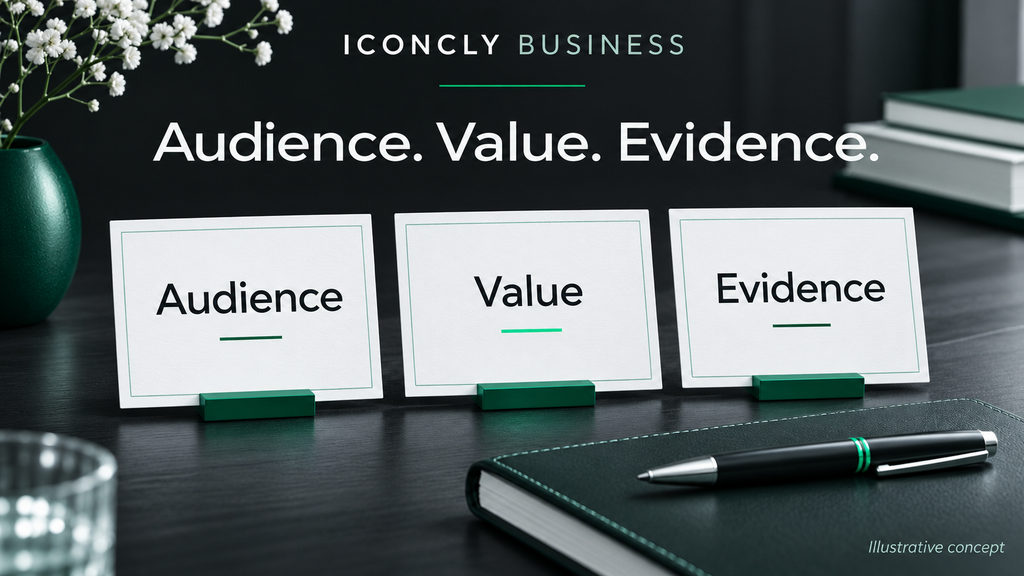
The common pattern is a relationship between a central idea and a practical explanation. None of the lessons requires copying the brand’s wording or visual identity.
Use these questions when evaluating another example:
- Can I identify the offer without reading the entire page?
- Does the message connect with a problem or decision the buyer recognises?
- Do the supporting details explain the headline?
- Can the business substantiate what it claims?
- Does the next action match the reader’s likely level of readiness?
Record the specific language or page element behind your answer. That turns inspiration into an evidence-based brief rather than a collection of slogans.
Brand messaging examples for consultants and service businesses
The following before-and-after examples are hypothetical teaching examples. They are not client testimonials, approved positioning statements or reported results. Each requires validation against the business before publication.
Example 1: a management consultancy
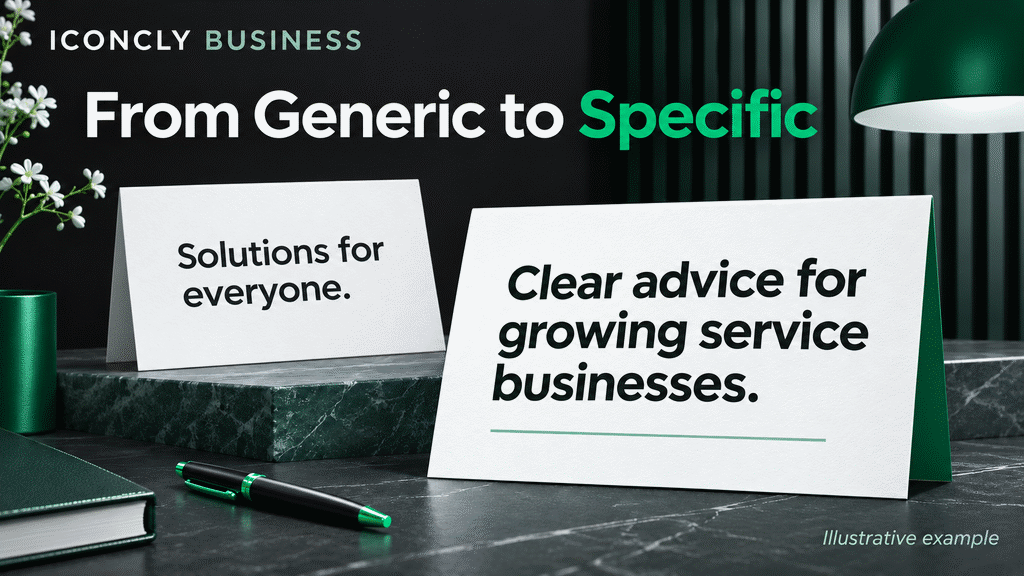
Generic message: “We deliver innovative solutions that transform businesses.”
More specific direction: “We help growing professional service firms clarify their operating priorities before expanding their teams.”
Why the second direction is more useful:
- It identifies a business type.
- It names a decision context.
- It explains the role of the advice.
- It avoids an undefined transformation promise.
Evidence to add might include a documented diagnostic process, an anonymised sample deliverable or an approved case study explaining the actual engagement. Do not add growth percentages unless the company can substantiate them.
Example 2: a specialist advisory founder
Generic message: “A trusted leader with a passion for excellence.”
More specific direction: “I advise founder-led service businesses on positioning, offer clarity and the decisions behind market expansion.”
This version gives a prospective client a clearer reason to continue reading. The biography can then explain relevant experience, professional background and the founder’s approach.
For leaders whose individual reputation shapes the business, personal branding advisory is relevant to how that identity is expressed. The message should reflect the person’s genuine expertise.
Example 3: a premium B2B service provider
Generic message: “Your partner for end-to-end business success.”
More specific direction: “We organise complex service offers into clear proposals, scope documents and buyer-facing explanations.”
The benefit is easier to assess because the message names the work. Buyers can ask informed questions about deliverables, responsibilities and fit.
Before publishing, confirm whether the company actually provides all three items. Removing an unsupported capability is more valuable than keeping a sentence artificially impressive.
Build a practical brand messaging framework
Step 1: choose one priority buyer
Start with the audience you most need to reach. “Businesses of all sizes” provides little guidance for a specific website page or proposal.
Describe the buyer’s role, organisation type, decision and immediate concern. A founder preparing to expand a consultancy may need different information from a procurement team comparing established providers.
Separate audiences when their needs differ materially. One core business position can support several audience-specific messages without making every page identical.
Step 2: identify the problem in the buyer’s language
Review genuine sales questions, discovery notes and approved customer feedback. Look for recurring uncertainty: unclear scope, difficult comparisons, inconsistent explanations or an offer that appears too broad.
Do not invent customer research. If evidence is limited, label the assumption internally and plan how to test it.
Write the problem as a situation the buyer recognises. “Our services are excellent” describes your opinion; “buyers cannot tell which service fits their need” describes a decision barrier.
Step 3: define the value and its limits
Explain what the business helps the buyer understand, decide or accomplish. Distinguish the work delivered from the eventual commercial outcome.
An advisory engagement may provide a market assessment and recommendations. Whether those recommendations produce revenue also depends on implementation, market conditions and other factors.
Avoid turning an intended benefit into a guaranteed result. State the scope precisely enough for the buyer to evaluate.
Step 4: connect every important claim with proof
Create a simple evidence inventory:
| Claim | Possible supporting evidence | What to check |
|---|---|---|
| Specialist expertise | Relevant background and documented practice focus | Accuracy and relevance to the buyer |
| A structured approach | Process description and sample deliverable | Whether the described steps are actually used |
| Relevant experience | Approved case study with defined scope | Permission, attribution and outcome limitations |
| Clear delivery | Sample scope, responsibilities and milestones | Consistency with the real engagement |
Evidence does not always require a large statistic. A clear explanation of the process can substantiate how a company works, although it cannot prove a performance result.
Step 5: write a hierarchy, then adapt it
Draft the core message first. Add three supporting themes and the proof behind each one. Then adapt the emphasis for the website, founder biography, proposal and content.
For each version, preserve the audience and underlying offer. Change the amount of detail and the next action to suit the context.
A useful working template is: “We help [defined audience] address [specific problem] through [actual approach], supported by [relevant evidence].”
Treat this as a planning tool, not a sentence every company should publish unchanged.
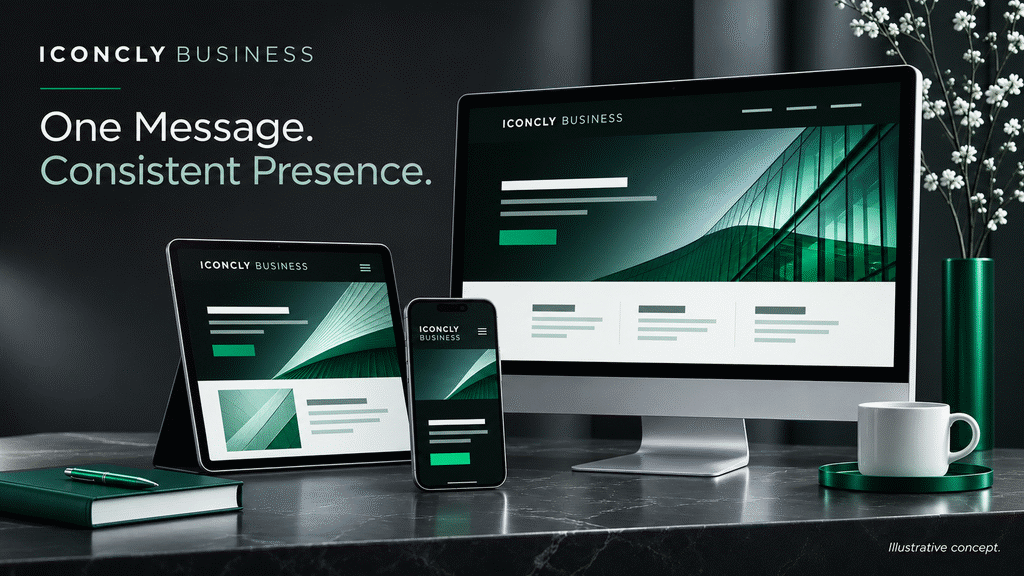
Apply one message across your main business touchpoints
Your website: explain the offer before expanding the story
Use the homepage to establish relevance, then let service pages explain scope, evidence and next steps. An authority website brief should define the information a serious buyer needs, not simply a preferred visual style.
ICONCLY’s website authority pathway is a relevant place to discuss that structure. Confirm the advisory and implementation scope in the engagement rather than assuming every requirement belongs to the same service.
LinkedIn: connect the public identity with a consistent perspective
The founder’s introduction, profile and posts should make sense together. A person who describes themselves as a specialist on the website should not publish an unrelated stream of generic advice.
LinkedIn authority guidance can support decisions about audience, profile narrative and content direction. The objective is coherent professional communication, not repeating the same promotional sentence in every post.
Thought leadership: develop the idea beyond the claim
A strong point of view explains how the expert thinks. It can explore a trade-off, challenge a common assumption or show how to evaluate a decision.
Connect that thinking to the brand’s actual focus. Thought leadership content strategy should deepen the message with useful reasoning and evidence.
Founder visibility: maintain recognisable context
Biographies, interviews and public appearances should retain the same essential identity even when their length differs. Founder visibility strategy provides a relevant route for discussing that consistency.
If the underlying offer still sounds different across these channels, start a diagnostic conversation before commissioning more content.
You can also email ICONCLY Business with your website and messaging challenge, or call +971 50 0521 2178 to discuss the appropriate next step.
Adapt messaging for UAE and US audiences
Use the same evidence standards in both markets, while checking the audience’s expectations and decision context. Do not assume every UAE buyer requires the same language mix or every US buyer responds to the same style.
Where Arabic and English are required, preserve the approved meaning and commercial scope. Translate naturally, then review important terms such as advisory, delivery, partnership and guarantee.
Keep geographic claims accurate. A UAE headquarters does not establish a US office, and international availability does not automatically demonstrate experience in every industry.
For founders entering a new market, distinguish existing evidence from plans. A clear explanation of relevant capability is more credible than a claim of local leadership without supporting information.
Test your message before scaling it
Ask a small group of relevant buyers to explain the offer in their own words. Note what they understood, what they could not distinguish and which claims prompted questions.
This is qualitative feedback, not proof of conversion improvement. Combine it with appropriate website and enquiry data over time.
Useful review points include:
- Whether enquiries match the intended audience and service.
- Whether prospects repeatedly ask what the company does.
- Which pages support meaningful contact requests.
- Whether staff describe the offer consistently.
If you test alternative messages, document what changed and the context. More enquiries can result from changes in traffic or campaigns, so avoid attributing every movement to wording alone.
How ICONCLY approaches the messaging problem
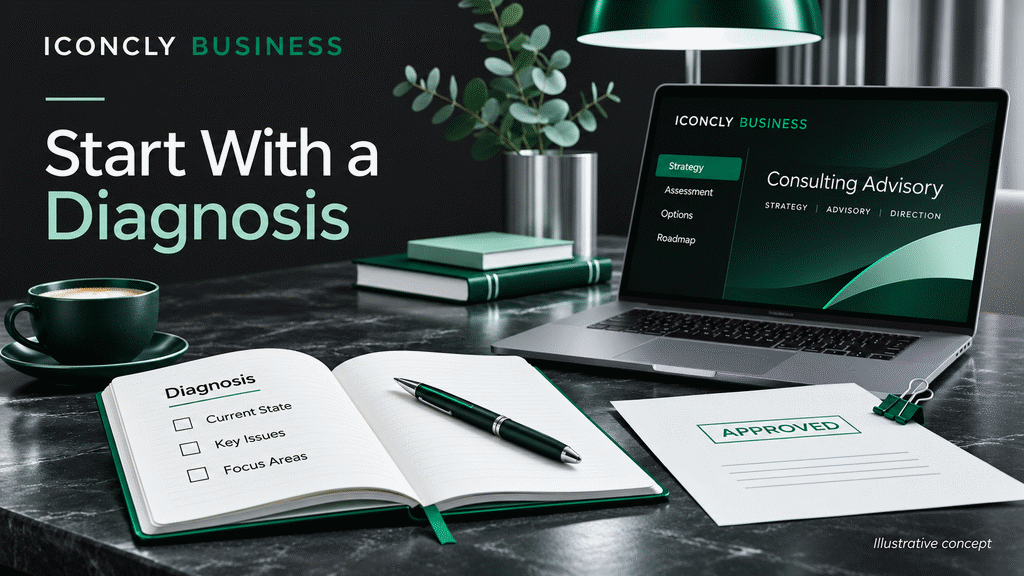
ICONCLY Business presents itself as a diagnostic-first advisory practice. Its Diagnostic Audit and Positioning Strategy pathways provide the relevant entry points for assessing unclear positioning and defining communication direction.
Bring the current website, priority audience, service scope and available evidence to the discussion. The useful first decision is whether the issue sits in audience selection, differentiation, proof or expression.
These brand messaging examples are teaching references. They are not ICONCLY client results. A proposal should distinguish advisory outputs, implementation responsibilities and the measures used to review progress.
Frequently asked questions
What are brand messaging examples?
They are real or clearly labelled illustrative expressions of how a business communicates its audience, offer and value. Useful analysis explains the reasoning and supporting evidence, rather than listing slogans alone.
Is brand messaging the same as a tagline?
No. A tagline is a short expression. Messaging includes the fuller hierarchy of value, supporting themes, evidence and channel guidance that helps buyers understand the offer.
Can I use another brand’s message for my company?
Use examples to understand the structure, then write for your own audience and capabilities. Copying another company’s language can create inaccurate expectations and weaken differentiation.
How many brand messages does a business need?
Start with a clear core message and enough supporting themes to explain the offer. Add audience-specific versions when the needs differ, while keeping the central position consistent.
Can clearer messaging guarantee more enquiries?
No. It can help buyers understand relevance, but enquiries also depend on demand, visibility, credibility, pricing, service fit and the contact process.
Make your next message easier to understand and evaluate
The most useful brand messaging examples connect a clear idea with a practical explanation and credible support. Apply those principles to a real audience, then check whether the resulting message matches what the business actually provides.
Discuss your messaging challenge with ICONCLY Business. Share your current website, the buyers you want to reach and the part of your offer that feels difficult to explain so the conversation can begin with a defined problem.
Prefer a direct conversation? Email info@business.iconcly.com or call ICONCLY on +971 50 0521 2178. Include your business name, website and the message you want to clarify.